This session is part of Reflective Meditation’s Daily Online Meditation practice at reflectivemeditation.org/dailyonline.
Linda continues the whys with a pair of questions about what we do after we meditate. Why do we tell meditators to stay close to their experience, and why do we suggest journaling afterward? Along the way she shares a story from her in-person Saturday group, and a moment of humor about retreat chairs.
* * *
Protecting your relationship with your own experience
I’m continuing on a topic we started about the whys of Reflective Meditation. It’s been so helpful for Nelly and me to take it up, so we can be a little more transparent and also review some of the reasons we ask you to do the things we do in this practice.
Today and tomorrow I’ll offer two more whys, both about protecting your relationship with your own experience. Nelly kicked it off on Thursday by asking why we don’t immediately offer advice or resources when somebody shares about their meditation. I’m going to follow up with why we encourage you to stay with and learn from what you discover in meditation. Tomorrow I’ll talk about the conversation we have afterward, so we can help people discover what they want to explore from their meditation without taking it over.
My why today: why do we tell meditators to stay close to their experience and journal after meditation?
Your experience is your resource
We consider your experience your resource. Your inner life is your resource. We’re asking you to stay close to it so you can know it, reflect upon it, and learn from it. This takes time. It really is a long-term training in the way we enact sati, which in Reflective Meditation we translate as awareness.
If you come to the group fairly often, you’ll hear us say that your experience is your teacher. We’re here to be with you on that journey. We’re not here to be the teacher of your experience. That’s something we want you to discover for yourself, though we’re doing the same thing right alongside you.
This is one of the places where Reflective Meditation differs from other approaches. In many settings meditation instructions are clearly defined, and the emphasis is on developing a particular kind of mindfulness or insight. You don’t always know what you’re supposed to be discovering, but there’s an idea that you should discover something in a certain direction. That strong focus can look like returning to a chosen object, or it can be given to you, like observing impermanence, developing a particular quality, or practicing metta. The end game is given to you at the beginning. Reflection can certainly happen in those practices, but the meditation itself is the primary vehicle for your work.
In Reflective Meditation, we actually think the meditation is the jumping-off point. It’s the beginning rather than the end of the practice that day. What happens in meditation, once you remember it, is what you further reflect upon, and we want to give those experiences a little more room.
Why we journal
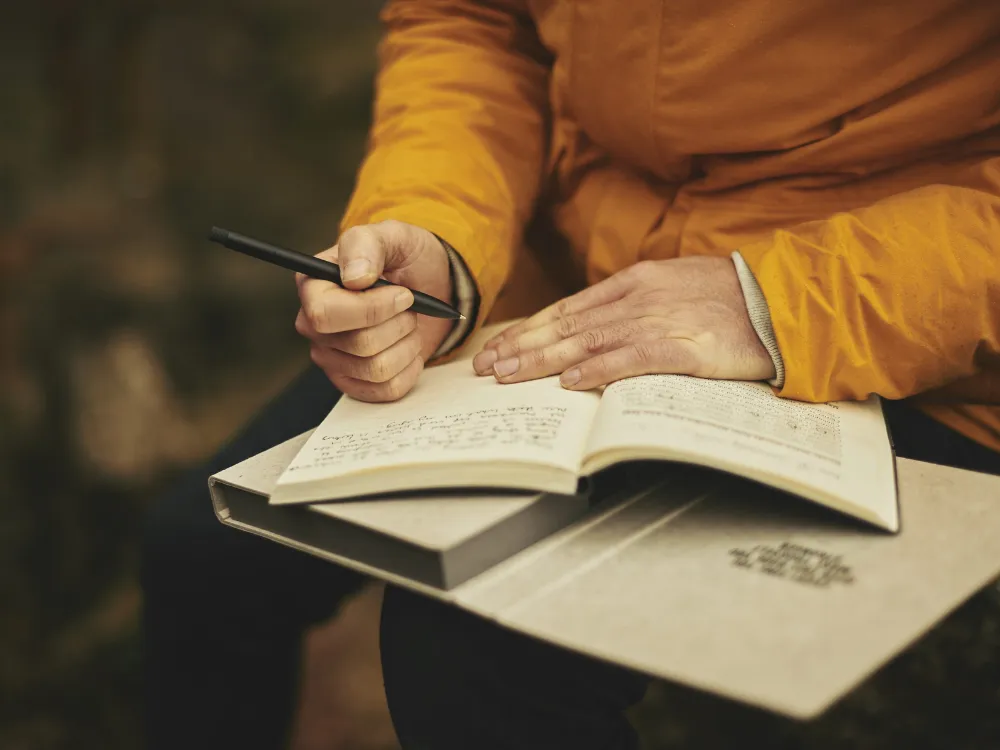
That’s one reason we suggest journaling. Writing something down helps us remember it. It gives us a little more evidence, which was a funny word that came to my mind, because we’re not claiming that what we write is 100% accurate, or proof of being right, or proof of anything. We’re asking people, ourselves included, to be closer to honesty, as honest as we can be at that time. Sometimes I can’t be that honest yet, but down the road I can.
When you’re writing, you can ask yourself: what did I notice, what seemed important, what do I remember from the meditation? You don’t have to write down every little detail, and we’re not necessarily looking for a linear account. When you’re new to this kind of practice you may need some help remembering, so we often suggest you start with whatever comes to mind first. Do what’s easy. Once you’ve written down a few things, you have some ground to reflect upon and explore, and that’s the world we want to look into in the conversation after reflection.
A story from Tai Chi
In my Saturday group, an in-person group where I pair Tai Chi moves with Reflective Meditation, we practiced some Tai Chi walking this week before we sat down. One woman told us about her experience afterward. She said she felt no tension while doing the walking. But it was that absence that, once she meditated, opened up some painful memories of being a child, running around the house trying not to be heard, being seen but not heard. Then she remembered a time later in life when she had broken her ankle, and how hard it was to walk without pain. She remembered the tension and pain of those scenarios, and she was surprised that she wasn’t engulfed in it. She was curious how this had come together without any conscious intention or effort to heal, and yet it felt very healing for her.
Obviously it doesn’t always happen this way, though that’s one of my favorite kinds of meditation. We have all sorts of experiences in meditation, which is another reason to write them down. We have our own hierarchies of what we like and don’t like, what we’d call more meditative or less meditative. Journaling helps us catch our mental and physical patterns more clearly, and start to see them as patterns rather than our fault, their fault, or somebody’s fault.
It doesn’t have to be journaling
Many of us have been practicing for years, and this training can look a little different for us. We may remember just one thing and journal about that, or remember something after the meditation and go into it in more depth. It plays out differently for all of us.
By the way, you don’t have to journal every time. And even if you don’t like writing, it isn’t a have-to. You could draw something. You could take a walk and let yourself remember the meditation. You might close your eyes for a moment and bring it back to mind. What we’re suggesting is that you do something after meditation to mark that experience in your awareness, rather than immediately moving on to whatever comes next, because it’s really hard to remember once you’ve moved on. We can look at it as an intention or acknowledgement that experience matters, and that there’s something worth learning from it.
Reflective meditation chairs
On Thursday, Nelly and I were talking about our upcoming retreat. We’re doing something new, a hybrid retreat, with some people in person and some online, and we’re trying to come up with creative ways to combine the rooms. In the in-person section, many of us sit on chairs these days, and I’m happy I don’t have to scrounge around for all the pillows and back support I needed even when I was younger. The people at Friends of Dama, where we’ll be retreating, have gone to quite a bit of effort to find chairs that are accessible for people with physical issues. They even have a little pouch on the back. Nelly was describing them and said, “Oh, that pouch must be for our journals.” And I thought, yay, reflective meditation chairs!
The pouch is actually for hymnals. A whole different reason. But we both agreed how sacred our journals are.
A precious resource
They really are a precious resource, even if you never review them again, just for that time to write something down after the meditation. Not because it’s some profound truth, but because it’s the material of our learning from experience. It’s a way of saying that what happens in our meditation is worth attention, and reattention. It’s worth remembering and re-remembering, worth getting to know, and we deepen our knowing by getting to know it better.
I’m out of words, so we’ll end here.